As the Taliban prepare to mark five years in power this week, a UN agency’s grim accounting of Afghanistan’s education crisis finds an unlikely echo in a cramped flat in Karachi — where an Afghan family’s exile tells the human cost behind the statistics.
For nearly half a decade, Afghanistan has held a distinction no government wants: it is the only country on earth where girls and women are formally barred from secondary and higher education. This week, as the Taliban prepare to mark five years since seizing power amid a slow thaw in international engagement, the United Nations Educational, Scientific and Cultural Organization (UNESCO) has laid out just how deep that distinction cuts — in numbers that stretch decades into the future, and in the quieter, harder-to-quantify toll on families who have already fled its consequences.
A Ban That Was Never Supposed to Last
When the Taliban swept back into power in August 2021, following the withdrawal of American and allied forces, the group offered the international community a specific assurance: girls and women would keep their access to education. It did not survive the year. Girls’ secondary schools were shuttered in March 2022. By December of that year, women were locked out of universities as well. Taliban officials called the measures temporary. Five years later, they remain fully in force.
According to UNESCO, the human toll of that broken promise now stands at 2.4 million Afghan girls denied a secondary education since 2021 — a generation raised in a system built, deliberately, to exclude half of it.
The Price Tag of Exclusion
UNESCO’s projections attach a hard economic cost to the policy. By 2066, the agency estimates, the education ban could push 600,000 Afghan women out of the workforce entirely, dragging $9.6 billion out of the country’s GDP. The restrictions are also expected to drive up rates of child marriage — a consequence UNESCO warns compounds the damage across generations rather than confining it to the present one.
The classroom crisis has a supply-side dimension too. With women barred from teaching boys, Afghanistan is on track to face a shortfall of 11,000 qualified female teachers by 2030. Hoda Jabiran, UNESCO’s Programme Coordinator for Education and Emergencies, described the practical result bluntly: boys’ classrooms are increasingly staffed by unqualified male teachers, where they are staffed at all. “We are left with unqualified male teachers or no teachers at all,” Jabiran said.
The Taliban’s Ministry of Education did not respond to requests for comment on the findings.
A Literacy Crisis Beneath the Headlines
The damage is not confined to girls alone. UNESCO’s data paints a picture of a national education system in broad collapse: more than 90 percent of 10-year-old children in Afghanistan cannot read a simple text, and the national literacy rate has fallen to just 37 percent. Overcrowded classrooms and crumbling infrastructure have deepened the crisis, made worse by the return of roughly 3 million Afghans expelled from neighboring countries in 2025 alone — many of them children who now need places in a school system that barely has room for the students it already had.
Natural disasters have added their own toll. More than 1,000 schools have closed since 2021 because of earthquakes and floods, stripping capacity from a system with almost none to spare.
The Restrictions Follow Families Across Borders
UNESCO’s report captures Afghanistan in aggregate. What it cannot capture is what the policy looks like from inside a single household — one that made the calculation that leaving was less dangerous than staying.
That calculation is one an Afghan man now living in Karachi knows intimately. For security reasons, he is identified here only by the pseudonym Akmal. He told Tribune GB he left Afghanistan because of the ban on girls’ secondary and higher education, compounded by what he described as the extremely poor quality of schooling still available to boys. He has now lived in Karachi on a transit visa for more than a year, part of a five-person household: his wife, two sons, and a daughter.
Akmal is visually impaired — he says he has three percent vision remaining, with no available treatment — and his wife received little formal schooling of her own. Neither can work in any conventional sense, and the family has no independent source of income. They survive entirely on the support of philanthropists within Karachi’s community, who cover their rent, their household expenses, and their children’s school fees.
“Obviously, who would want to leave their homeland and home behind and live such a difficult life in another country — especially under circumstances where there is no source of income and one’s physical condition is such that it is not possible to go out and work?” Akmal said. “According to my medical report, I have only three percent vision left, and there is no treatment for it.”
His account is a reminder that behind every projection in a UNESCO report — every percentage point of lost GDP, every teacher shortage figure — sits a family that has already made an irreversible decision about where, and how, to live.
Beyond the Classroom: A Widening Campaign
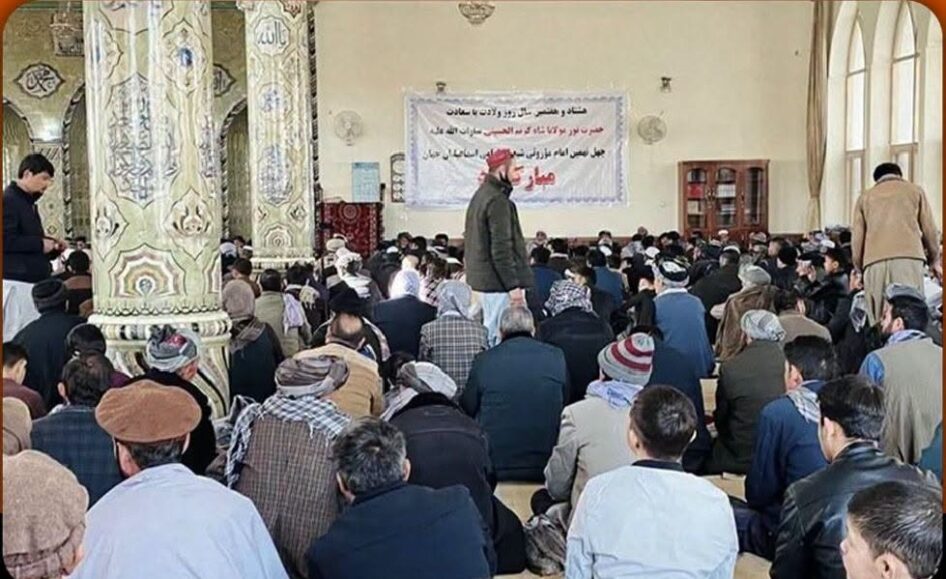
Akmal also pointed to a dimension of Taliban policy that extends well past education: a tightening campaign against religious minorities and their places of worship. According to the United Nations Assistance Mission in Afghanistan (UNAMA), in its most recent quarterly report, the Taliban have ordered the closure of 33 Jamatkhanas belonging to the Ismaili community in Badakhshan province — 17 in Zebak, 14 in Ishkashim, and two in Wakhan — with orders that they be converted into mosques.
UNAMA traces the campaign to January of this year, when it was initiated by the Taliban’s Ministry for the Promotion of Virtue and Prevention of Vice. The report describes it as an ongoing effort that has prevented Ismaili citizens from carrying out their religious practices.
Shia Muslims have faced their own tightening restrictions, per the UNAMA findings: Ashura commemorations were curtailed this year, and 45 people were detained in Kabul for displaying religious flags.
A Pattern, Not an Anomaly
Taken together, the UNESCO findings and UNAMA’s reporting describe a governing approach in which restriction is not incidental but structural — extending from girls’ classrooms to women’s employment and freedom of movement, and outward again to the religious practices of minority communities. The Taliban maintain that these policies reflect religious law and Afghan cultural values.
Five years after taking power on a promise that women’s access to education would be preserved, the Taliban govern a country where that promise was abandoned within months — and where the consequences, by UNESCO’s own accounting, are only beginning to compound. For families like Akmal’s, watching from a rented flat in Karachi, the arithmetic of that failure is not a projection for 2066. It is already the shape of daily life.