A UN mission’s quarterly report confirms the closure of more than 30 Jamatkhanas in Badakhshan province. On the ground, Ismaili residents describe something broader still: a coordinated push of conversion incentives, jihadi schooling, and unpunished violence aimed at dissolving a centuries-old community.
In the remote valleys of Badakhshan, in Afghanistan’s northeast, a religious community that has worshipped there for generations is watching its spaces of prayer disappear one order at a time. According to the United Nations Assistance Mission in Afghanistan (UNAMA), the Taliban have shut down at least 33 Ismaili Jamatkhanas across the province since January — and residents say the closures are only the most visible piece of a much wider campaign.
What UNAMA Found
UNAMA’s latest quarterly report, covering April through June and released this week, documents a systematic effort by the Taliban’s Ministry for the Promotion of Virtue and Prevention of Vice — working alongside several other government bodies — to close Jamatkhanas, the sacred prayer spaces of the Ismaili Shia community, and to bar worshippers from using them. The scale is province-wide: 17 Jamatkhanas closed in Zebak district, 14 in Ishkashim, and two in Wakhan. Taliban officials have told local communities the buildings should be repurposed as mosques.
When UNAMA raised the closures with the Taliban’s Foreign Ministry, officials offered a more measured account, saying field assessments had found conditions varied from one Jamatkhana to the next and that decisions were made case by case. Some areas, the ministry said, simply lacked mosques; some of the closed buildings, it claimed, had been functioning as residential structures rather than active prayer halls.
The report also documents parallel restrictions on Afghanistan’s Shia Muslim population more broadly. During Ashura, the Taliban instructed Shia communities in Parwan and Logar provinces to hold their commemorations only inside designated mosques, and UNAMA confirmed that 45 Shia men were detained in Kabul simply for displaying Ashura flags.
A Community’s Account Diverges Sharply From the Official Line
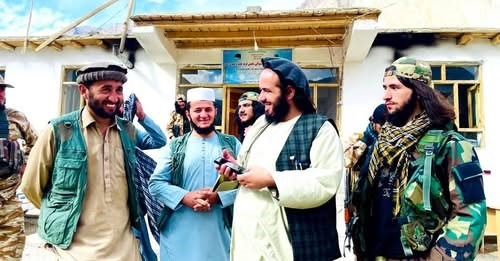
Where the Taliban’s Foreign Ministry describes a measured, case-by-case process, Ismaili residents of Badakhshan describe something far more sweeping — and far more coercive.
Local community members say the pressure extends well beyond building closures into daily life itself, layering religious repression on top of physical danger. In Fayzabad, the provincial capital, residents report systematic and repeated attacks on Ismailis; in the most recent incident, unidentified gunmen shot and seriously wounded two Ismaili residents. Community members say no one has been held accountable.
Alongside the violence, residents describe an active campaign of religious pressure: the Taliban have reportedly issued official documents offering incentives and encouragement to Ismailis willing to abandon their faith. It is, in effect, a paper trail of inducement — conversion framed as a transaction, backed by the implicit threat already visible in the closures and the attacks.
The Taliban have also advanced a historical justification for converting Jamatkhanas into mosques, according to residents: officials claim that some of the buildings now used as Jamatkhanas were originally mosques during the era of the Mujahideen, and that the conversions now underway are simply a correction of that history. Ismailis in Badakhshan reject the claim outright, saying the land was purchased and every cost of construction and maintenance covered through their own community’s personal contributions — that these are not disputed properties, but buildings the community built and paid for itself.
One Ismaili resident from Badakhshan, quoted by Daily Hasht-e Subh, described the scope of what community members believe is coming: “The Taliban want to turn Ismaili Jamaatkhana in Zebak, Ishkashim, Wakhan, and Shughnan into mosques. They have told us to attend mosques and change our religion. So far, they have closed the Jamaatkhana in Zebak.”
A School Built to Convert, Not to Teach
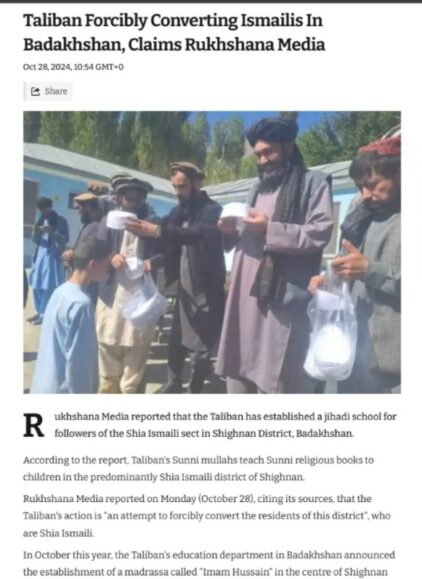
The pressure campaign extends into education as well — and here, its target is the community’s children. Rukhshana Media reported in late October 2025 that the Taliban had established what it described as a jihadi school in Shighnan district, a predominantly Ismaili area of Badakhshan, where Sunni mullahs now teach Sunni religious texts to local children.
The school, named “Imam Hussain,” was announced by the Taliban’s education department in Badakhshan the same month. According to Rukhshana Media’s sourcing, more than 200 boys from the district’s Ismaili community are now enrolled there, taught by instructors brought in from outside the district — all graduates of Taliban madrassas. None of the texts used in the classroom, sources told Rukhshana Media, belong to Ismaili religious tradition.
The irony, according to residents, is that Shighnan already had its own religious school for the Ismaili community — one that taught the theology of their own Shia tradition before the Taliban’s arrival. Residents describe the new institution as a deliberate replacement rather than an addition, teaching children not their own community’s faith but, they say, lessons on jihad, war, and extremism.
The Shighnan school is not an isolated initiative. By the Taliban’s own account, the group has established more than 21,000 religious schools across Afghanistan since retaking power — a network Taliban officials describe as central to preserving the movement’s influence and long-term hold on the country. Seen against that backdrop, the Shighnan madrassa reads less like a local policy decision than a data point in a nationwide strategy: extend the Taliban’s religious infrastructure into every community, including — perhaps especially — those it does not represent.
Three Fronts of a Single Campaign
Taken together, the elements documented by UNAMA and reported independently by Hasht-e Subh, Rukhshana Media, and Afghanistan International describe a campaign operating on three fronts at once: the closure and forced conversion of Ismaili sacred spaces, financial and social incentives for individual Ismailis to abandon their faith, and the quiet replacement of community-run religious education with Taliban-controlled schooling for Ismaili children.
Each front, taken alone, might be explained away — a zoning dispute, a generous offer, a well-intentioned school. Together, and set against a backdrop of unpunished shootings in Fayzabad, they form a pattern that Badakhshan’s Ismaili residents say leaves little room for a benign interpretation. For a community that says it built and paid for every one of the prayer halls now being shuttered, the message arriving from Kabul is not ambiguous.
What Comes Next
The Taliban’s Foreign Ministry has signaled to UNAMA that it does not consider the closures a uniform policy, leaving open the possibility of case-by-case reversals. But residents on the ground describe an expanding, not contracting, effort — one that has moved in less than a year from shuttering buildings in three districts to opening a dedicated school aimed at the faith’s own children in a fourth. Whether the international community’s attention, now sharpened by UNAMA’s own report, translates into any change in Taliban policy remains, for Badakhshan’s Ismaili community, an open and urgent question.