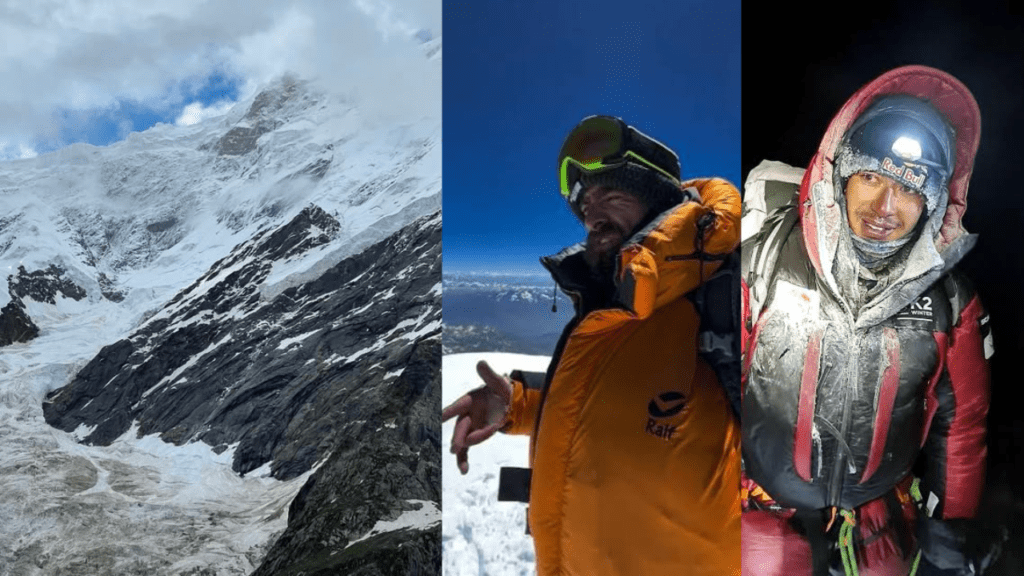
Days before an avalanche swallowed a team of ten climbers on Pakistan’s Broad Peak, Nirmal “Nims” Purja sat down and wrote a message to the world that now reads less like a training update and more like a manifesto.
“The mission shifts. The compass holds,” he began — a line that, in hindsight, feels less like a caption and more like a warning of what was coming.
A Detour That Became a Destiny
Purja hadn’t planned to be on Broad Peak at all. The expedition, as he described it, existed for one purpose: Gasherbrum II, part of what he called the “Hattrick project.” But somewhere in the final days before departure, while reviewing the ledger of his own career — the mountains climbed, the ones still standing — a new equation revealed itself.
If he added Broad Peak to the itinerary while he was already in Pakistan, only one eight-thousander would remain untouched: Cho Oyu. Complete that, and Purja would become the first person in history to climb all 14 of the world’s 8,000-meter peaks twice — without supplemental oxygen. A double. No, he corrected himself: a triple, counting the original Project Possible run.
It’s the kind of realization that sounds almost casual in his telling — “opportunities don’t scream: they whisper to those already working in silence” — but it reflects the calculus that has defined his entire career: relentless, self-authored, and allergic to standing still.
The Man Against Himself
If there’s a thesis buried in the post, it’s this: Purja has never seen mountaineering as a competition with other climbers. “My only battle was against the man I was yesterday,” he wrote, describing a discipline built entirely around internal benchmarks — a compass, in his words, that belongs to no one else. “The moment you look sideways… you drift off your compass.”
That framing extended into a rare, pointed defense of his most scrutinized achievement: Project Possible, the 2019 expedition in which he climbed all 14 of the world’s 8,000-meter peaks without bottled oxygen, later chronicled in Netflix’s 14 Peaks. Purja pushed back on years of criticism, cataloging what the cameras caught and what they didn’t — multiple rescues of climbers abandoned by other expeditions, self-funded logistics, route-fixing done by his own team, a Shishapangma permit negotiated directly with Chinese authorities, and hospital visits for his mother’s surgery squeezed in around it all.
“The noise hasn’t stopped,” he wrote. “I just stopped listening.”
He backed the claim with a receipt of his own: five of Pakistan’s five 8,000-meter peaks climbed in 26 days, without oxygen, while guiding others — breaking, he noted, the records of climbers who had once broken his, using bottled air to do it.
A Message to the Mountain
Then the tone shifted from defiance to something closer to reverence. “Broad Peak, I ask for nothing but safe passage up and back down,” he wrote. “I take zero mountains for granted. Not one. The moment my foot leaves basecamp, it’s 100%. Always has been. Always will be.”
He closed by dedicating the post to everyone who had carried him to that point — “supporters, critics, all of you” — insisting that his purpose was never really about personal glory, but about proof: that other people’s mountains, whatever form they take, are climbable too.
What Came After
On Thursday, an avalanche struck the ten-person team on Broad Peak. As of the latest reports, four bodies have been recovered; six climbers remain missing, including Purja himself. Search and rescue operations are ongoing in the Karakoram range.
Read today, Purja’s post carries a weight he couldn’t have intended when he wrote it — a document of a man mid-ascent toward a record no one else has touched, written in the unmistakable voice of someone who believed, as he always has, that the summit was simply a matter of time and will.