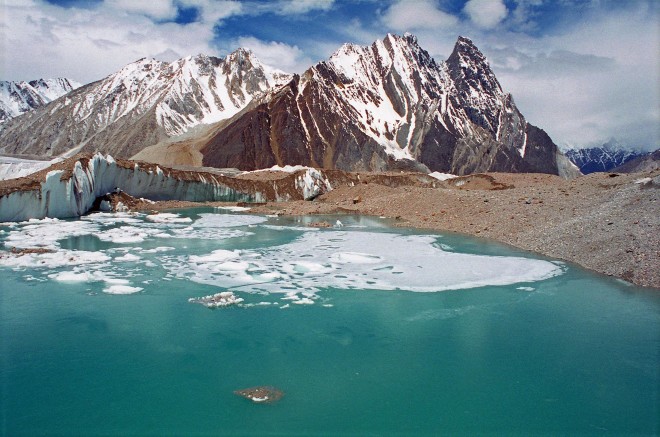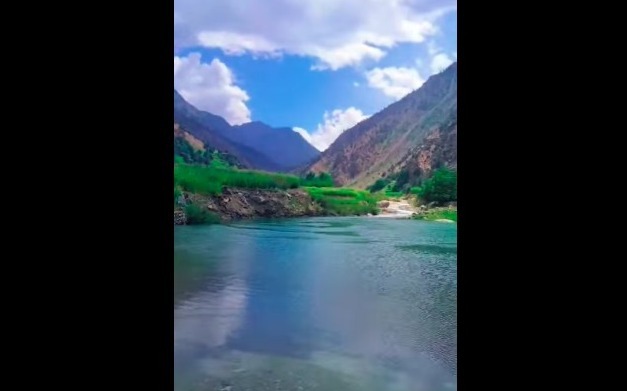
Gilgit-Baltistan, Pakistan — Rising temperatures and shifting weather patterns are taking a visible toll on one of the world’s largest glaciers outside the polar regions, as new observations show accelerated melting across the Baltoro Glacier in the Karakoram range.
Also read: 36 Glacial lakes pose threat in Gilgit Baltistan
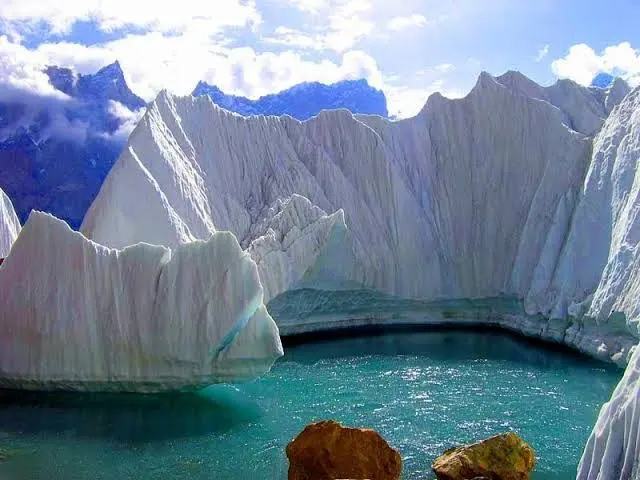
According to Independent Urdu, “between 25 to 30 lakes that have formed on the surface of Baltoro glacier as a result of melting ice, alongside large ice masses collapsing into caves”, the news site has concluded, based on observations by its correspondent, Mona Khan, who spent 12 days trekking across the Baltoro Glacier in 2024.
Terrain that once resembled solid rock, too hard to examine closely, is now visibly eroding — a shift researchers warn could intensify significantly over the next decade if left unaddressed.
Glaciers in Gilgit and Hunza face similar risk due to their lower elevation, while peaks near the Baltoro Glacier — including the Paiju mountains, once snow-covered year-round — are reportedly losing their summer snow cover, according to local residents.
According to climate change expert Asif Shuja, “global average temperatures are already rising by 1.5 degrees Celsius, and reaching 2 degrees could trigger severe consequences: accelerated glacier melt, worsening floods, rising oceans threatening coastal areas, and disruptions to global food supplies.” Shuja emphasized that voluntary emissions reductions by developed nations remain the most viable path to controlling global temperature rise.
According to estimates by The Intergovernmental Panel on Climate Change (IPCC), “the glaciers in the Himalayas could shrink by two-thirds by 2100, which would have significant implications for the region’s water resources, agriculture, and energy production.”
Also read: Flash Floods Wreak Havoc Across Gilgit-Baltistan, Causing Widespread Destruction
The Bigger Picture concerning Baltoro Glacier
Gilgit-Baltistan is home to three of the world’s seven longest glaciers found outside the Polar Regions — the Biafo, Baltoro, and Batura glaciers. The Baltoro Glacier alone stretches 63 kilometers, making it the second-longest glacier outside the Polar Regions, with roughly 30 tributaries and a surface area of about 1,291 square kilometers.
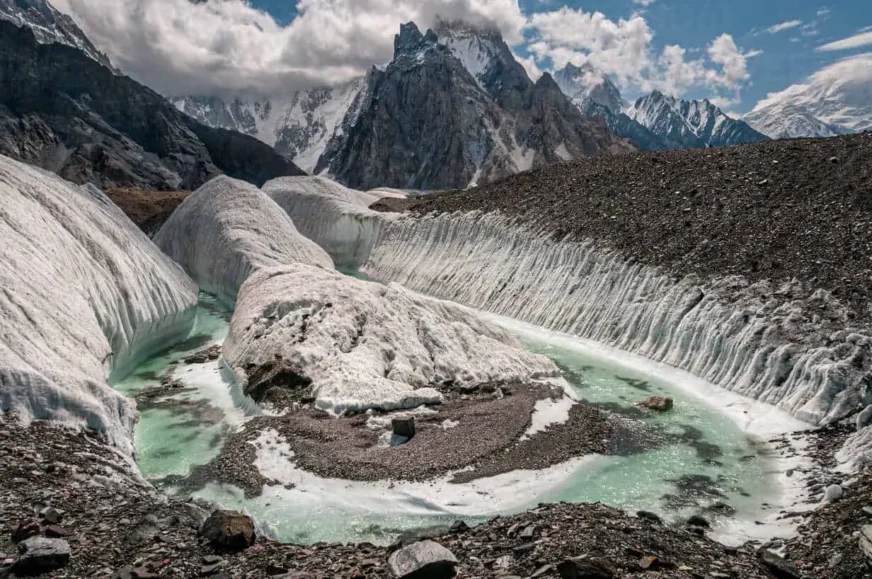
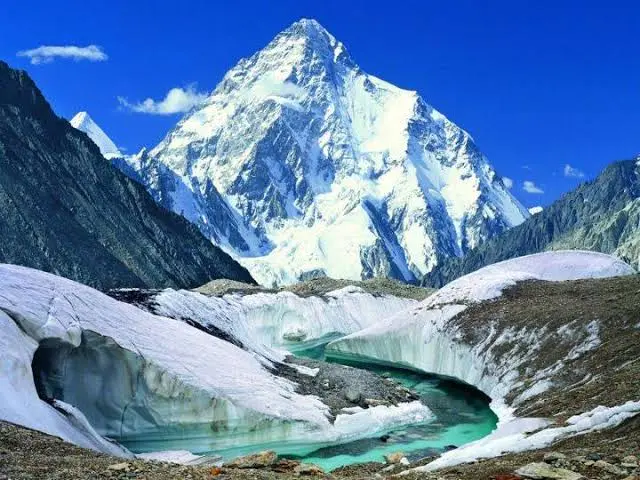
The Baltoro Glacier runs through the heart of the Karakoram range, near K2 — at 8,611 meters, the region’s highest peak — along with three other neighboring peaks that also exceed 8,000 meters. As an alpine glacier and the second-longest outside the Polar Regions, it has been measured to a depth of more than a mile.
Its surface hosts massive ice formations alongside clear meltwater streams that travel for kilometers through narrow channels before disappearing beneath the ice. That meltwater eventually re-emerges as a full-fledged river, flowing down the Baltoro valley toward the Indus River some 300 kilometers away.
The changes documented on the Baltoro Glacier reflect a broader pattern reshaping Gilgit-Baltistan’s high-altitude landscape. As melting accelerates and flood risk grows, the region’s glaciers — long considered among its most stable natural features — are emerging as an early warning sign of climate change’s impact on Pakistan’s north.
Consequences
Glacier melt has already contributed to more frequent flooding in mountainous regions over the past three years, including the devastating 2022 floods that began in Pakistan’s north before causing widespread human and financial losses nationwide. In 2025, an extra-ordinary glacial lake outburst flood (GLOF) had devastated several villages near Gupis, in Ghizer district of Gilgit-Baltistan.
Also read: Massive flood devastated Talidas valley of Ghizer
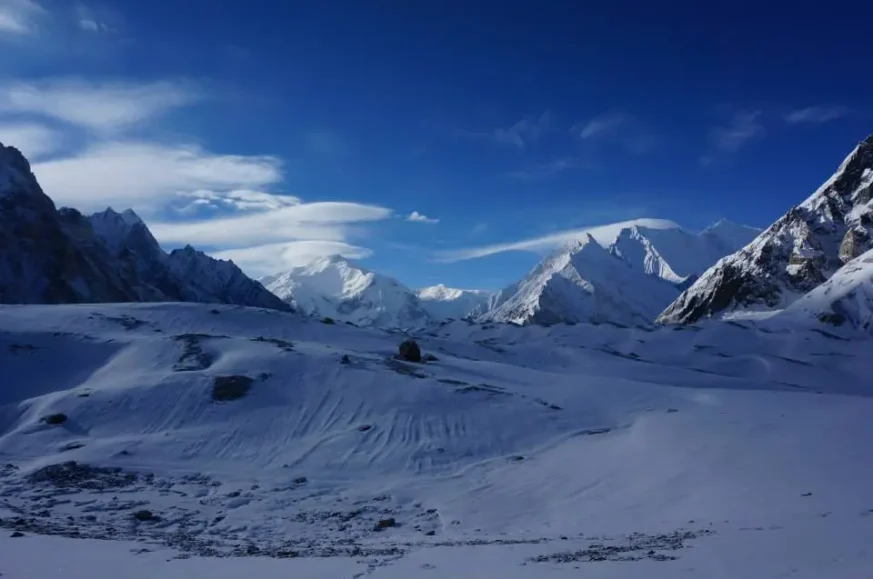
Pakistan remains among the countries most severely affected by climate change, and its northern glaciers are melting at an increasing pace as temperatures rise and weather patterns intensify. Last year, snowfall in the country’s northern areas arrived nearly three months later than usual, while heatwaves have placed additional strain on the major glaciers spread across the Karakoram region.
According to a report published in earth.com, “a combination of anthropogenic climate change and air pollution from neighbouring countries like India and China has significantly contributed to the rapid melting of these glaciers. The deposition of pollutants such as black carbon on the glaciers is causing them to melt at a faster rate.” A study published in the Journal of Geophysical Research: Atmospheres, estimates “up to 80% of the black carbon deposited on the glaciers in the Karakoram comes from outside the region.”
The Karakoram, world’s second largest mountain range, contains the largest concentration of glaciers outside the polar region. “These glaciers are a vital source of freshwater for the country, providing water for agriculture, industry, and its citizens. However, the rapid melting of these glaciers has become a matter of great concern for Pakistan’s economy.”
The disappearance of these glaciers, as a result of melting, is a significant concern, not only for the country but for the world as a whole.
References: