Jinhua, Zhejiang Province — Tucked away in Houjia Village, on the outskirts of Jinhua City, sits a place where the past has never quite stopped burning. Locals call it Guohuoyao — the Ancient Wuyao Fire — a pottery kiln complex that has been shaping clay into art for generations and, remarkably, still is.
Our first full day outside the city took us roughly an hour from central Jinhua’s Wucheng district out to this site, and it turned out to be one of the most unexpectedly moving stops of the entire trip. What we found wasn’t a museum in the usual sense — a place where history sits behind glass, untouched and finished. It was something closer to a living workshop, where centuries-old techniques are still practiced by hand, a few dozen meters from where their earliest examples are put on display.
Two Worlds Under One Roof
The Wuyao Fire complex blends two functions that rarely share the same address: a museum preserving ceramic history, and a working factory where artisans continue that history in real time. Walking from one wing to the other feels like stepping across a timeline — ancient vessels on one side, wet clay taking shape under a craftsman’s hands on the other.
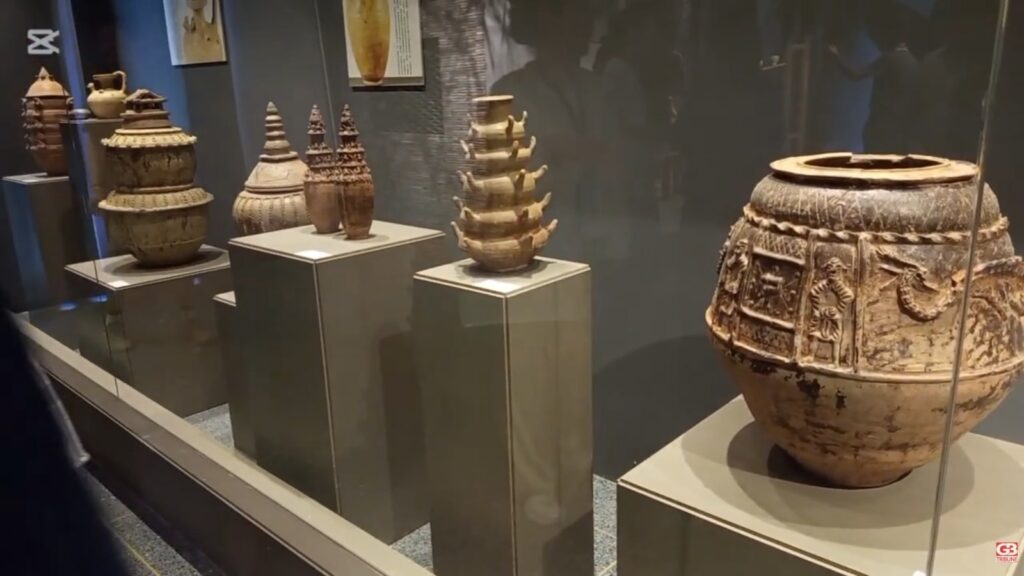
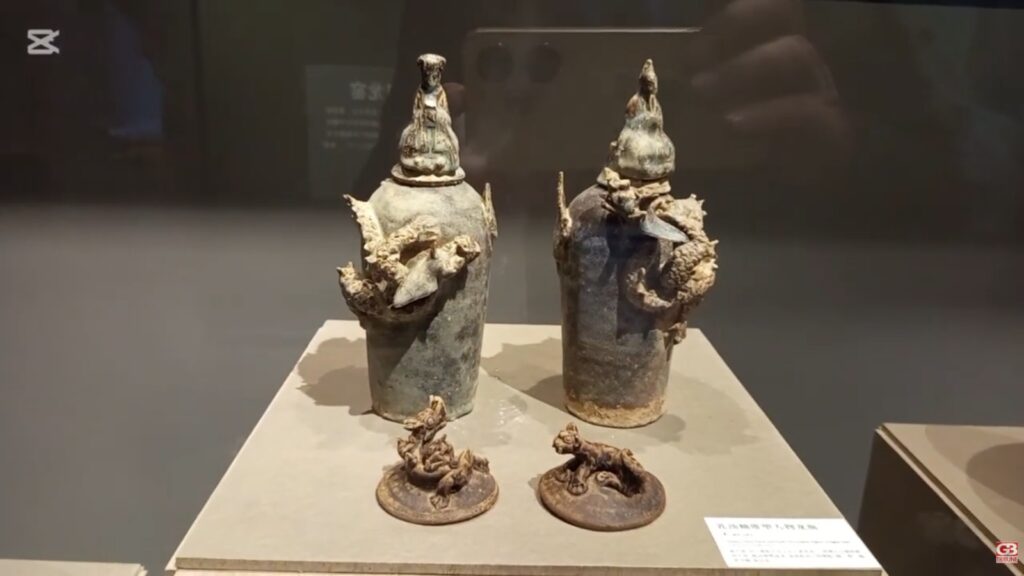
Inside the museum galleries, the collection spans multiple dynasties. Teacups, ritual vessels, figurines, and storage pots — some tied to the Qing era — sit in careful rows, each one a small record of the people who made and used them.
Jars Meant to Hold More Than Water
Among the most striking pieces are what scholars call “soul jars,” or hunping — funerary urns once placed inside tombs to accompany the dead.
These aren’t plain containers. Many are built with clusters of spouts stacked in tiers, a design meant to symbolize abundance and the continuation of a family line across generations. It’s no accident that the spouts so often come in groups of five — a nod to the traditional Chinese framework of five elements that was believed to govern balance in the natural world.
Elsewhere in the collection, ceramics reflect a distinctly Taoist sensibility: pieces built around ideas of harmony, contentment, and long life. Taoism’s core instincts — simplicity, restraint, moving with nature rather than against it — show up clearly in the shapes and motifs chosen by the potters who made them.
A Shipwreck’s Cargo, Frozen in Time
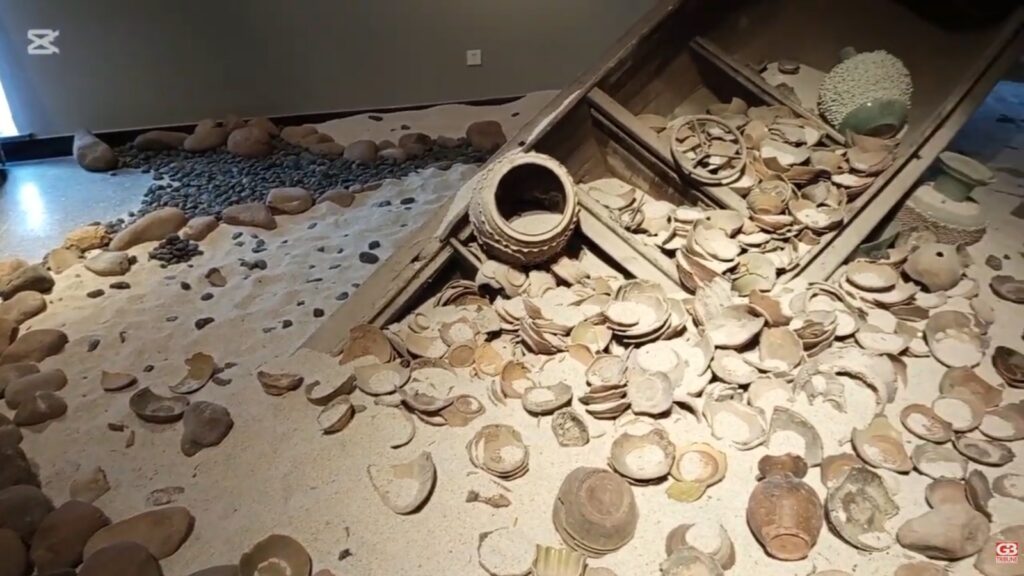
One gallery is devoted to a find that speaks to just how far Chinese ceramics once traveled. During the Song Dynasty, between 960 and 1279 AD, pottery production in China reached extraordinary heights — artisans refined glazing and firing techniques so effectively that demand for their work spread well beyond China’s borders, carried by ship along maritime trade routes across Asia.
Not every shipment made it to its destination. A vessel bound for Japan carrying 155 ceramic pieces sank before completing its journey — and in doing so, accidentally preserved its cargo for archaeologists centuries later. What was meant to be a routine trade delivery became a time capsule, offering researchers a rare, undisturbed look at Song-era ceramic styles and the trade networks that carried them.
Watching History Get Made
Throughout the tour, a museum guide walked us through the significance of each piece, her explanations carried into English by our host and translator, Victoria. It made the visit feel less like sightseeing and more like a conversation across centuries.
The most vivid part of the day came after the museum, in the factory itself, where craftsmen were shaping raw clay entirely by hand — the same fundamental process, essentially unchanged, that produced the pieces on display just steps away. The visit closed at the site’s massive kiln, the fire at the center of it all, where clay is still, today, turned into something built to last.
Wuyao Fire isn’t a monument to a finished past. It’s a place where craftsmanship, philosophy, and history are still being worked, fired, and passed down — one piece at a time.