
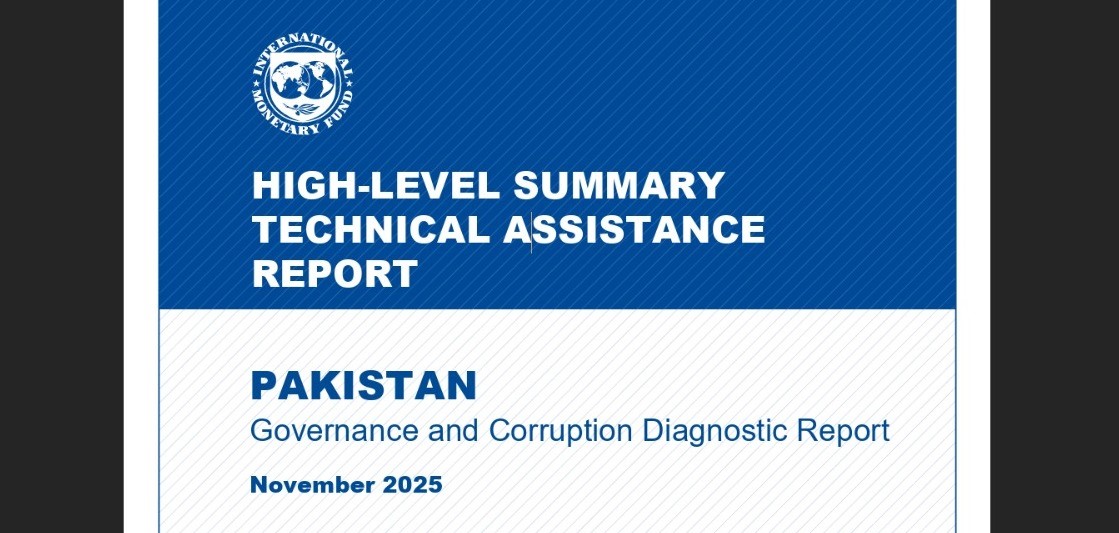
Islamabad — A new diagnostic report prepared by the International Monetary Fund (IMF) has warned that Pakistan’s governance weaknesses and entrenched corruption risks are undermining economic performance, discouraging investment, and obstructing long-term reform. The “Governance and Corruption Diagnostic Report,” released as part of the IMF’s high-level technical assistance series, was conducted at the request of the Government of Pakistan under the Fund’s Framework for Enhanced Engagement on Governance.
Prepared by a multi-disciplinary IMF team led by Joel Turkewitz, the assessment examines corruption vulnerabilities in five core state functions: fiscal governance, market regulation, financial sector oversight, anti-money laundering / counter-terror financing (AML/CFT), and the rule of law. The report also evaluates the effectiveness of Pakistan’s anti-corruption agencies and provides an integrated set of reform recommendations.
Persistent Corruption Risks Holding Back Economic Growth
According to the report, corruption remains a “persistent feature” of Pakistan’s governance landscape, with significant adverse effects on economic growth, public trust, and the business climate. Pakistan continues to rank poorly on global governance indicators, including control of corruption, contract enforcement, and property rights protection.
The IMF notes that Pakistan’s heavily state-dominated economy—marked by extensive government control over key sectors, complex regulatory environments, and overlapping institutional mandates—creates significant opportunities for rent-seeking and regulatory capture. Discretionary enforcement of rules, limited transparency, and weak oversight mechanisms further amplify corruption risks.
Fiscal governance is identified as a major vulnerability. The report points to a complex and opaque tax system, weak internal controls in the revenue authority, and a porous customs administration that collectively contribute to a low tax-to-GDP ratio. Public financial management is undermined by inaccurate budget forecasting, inconsistent execution, procurement weaknesses, and inefficient oversight of state-owned enterprises.
Market regulation, according to the diagnostic, suffers from excessive and duplicative rules, limited autonomy of regulators, and distortions benefiting politically connected firms. Judicial institutions are described as fragmented, overburdened, and vulnerable to corruption, resulting in major delays in resolving commercial disputes.
The report also highlights persistent shortcomings in anti-corruption bodies such as the National Accountability Bureau (NAB), the Federal Investigation Agency (FIA), and provincial anti-corruption establishments. These agencies, it states, lack adequate coordination, modern investigative capacity, and have historically been subject to political influence.
AML/CFT Improvements Not Enough
While acknowledging that Pakistan’s AML/CFT framework has improved—leading to the country’s removal from the Financial Action Task Force (FATF) grey list—the IMF stresses that enforcement remains weak. In particular, corruption-related money laundering cases are rarely pursued effectively, and international cooperation for asset recovery needs strengthening.
Comprehensive Reform Agenda Recommended
The IMF outlines a broad, sequenced reform program aimed at strengthening institutional integrity, improving transparency, and enhancing the rule of law. Key recommendations include:
Economic Governance
* Establish a dedicated tax policy office and simplify the tax system.
* Strengthen internal controls in revenue authorities and create an independent internal affairs unit to detect corruption.
* Enforce strict procurement rules and improve transparency in public investment and asset management.
* Rationalize the regulatory framework and digitize compliance processes to reduce official discretion.
Rule of Law
* Update outdated legal frameworks and reduce court backlogs.
* Improve transparency around court performance.
* Enhance judicial independence through stronger appointment processes, better working conditions, and oversight mechanisms.
AML/CFT
* Prioritize corruption-related risks and align resources with identified vulnerabilities.
* Improve beneficial ownership transparency.
* Remove legal ambiguities that hinder prosecution of money laundering cases.
Anti-Corruption Agencies
* Enhance independence, capacity, and transparency of NAB, FIA, and provincial bodies.
* Modernize investigative approaches and adopt risk-based prevention systems.
* Publish asset declarations as mandated by new laws.
* Improve leadership selection and strengthen case investigation and prosecution processes.
The diagnostic stresses that meaningful progress will require coordinated action across government institutions, as well as sustained engagement with the private sector and civil society. “Strengthening governance is essential to restoring public trust, improving economic performance, and sustaining reform momentum,” the report concludes.
1 thought on “IMF Report Warns of Deep-Rooted Governance Failures, Calls for Urgent Anti-Corruption Reforms in Pakistan”